
Ecommerce price data collection has become one of the most critical capabilities for online sellers, brands, and market analysts.
Whether you’re tracking competitors, optimizing dynamic pricing, or monitoring regional discounts, accurate pricing data directly impacts revenue.
However, collecting that data at scale is no longer simple.
Modern e-commerce platforms aggressively defend against automated traffic, making price scraping without getting blocked a serious technical challenge.
In this guide, you’ll learn:
- What is e-commerce price data collection is
- Why websites block price scrapers
- The best proxy strategy for reliable price monitoring
- How to avoid CAPTCHA, bans, and fake prices
- Proven tools and real-world best practices
What is Ecommerce Price Data Collection?
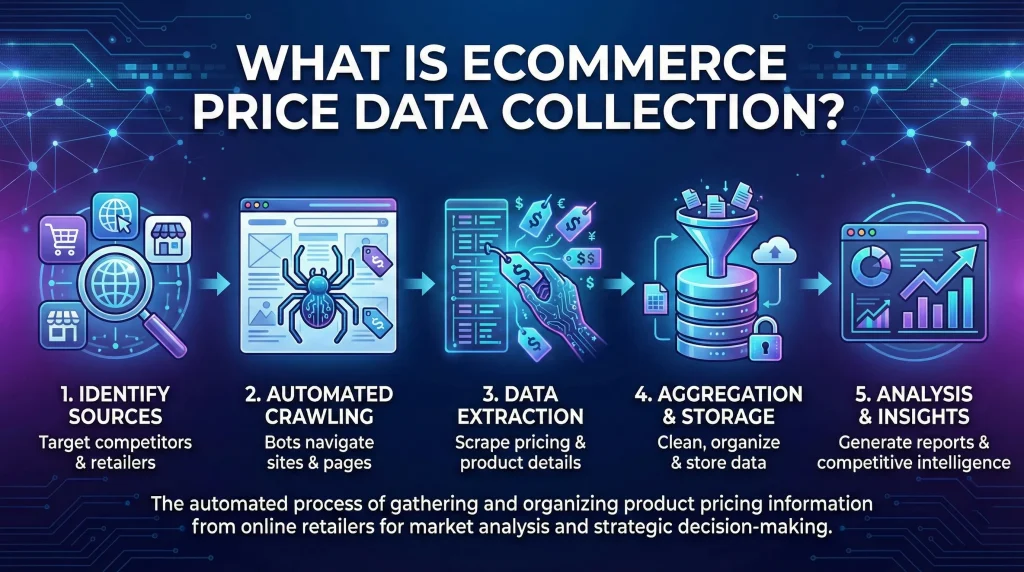
E-commerce price data collection refers to the automated process of extracting product pricing information from online marketplaces and retail websites.
Businesses commonly collect:
- Product prices
- Discounts and promotions
- Regional pricing differences
- Stock availability
- Shipping costs
This data is used for:
- Competitor price tracking
- Dynamic pricing automation
- Market research
- Product intelligence
- Revenue optimization
Why Is E-Commerce Price Scraping So Difficult Today?
Ten years ago, simple scripts could crawl e-commerce websites freely.
That era is gone.
Today, platforms like:
- Amazon
- Walmart
- Shopee
- Lazada
- eBay
Use enterprise-grade anti-bot systems that analyze:
- IP reputation and ASN type
- Request frequency and velocity
- Browser fingerprint consistency
- Session behavior
- Geographic mismatches
If suspicious activity is detected, websites may respond with:
- Temporary IP bans
- Permanent blacklisting
- CAPTCHA challenges
- Fake or localized prices
- Incomplete HTML pages
What Is the Biggest Risk in Price Data Collection?
Surprisingly, the biggest risk isn’t getting blocked.
It’s collecting incorrect pricing data.
Blocked or filtered responses often return:
- Wrong currency values
- Region-adjusted prices
- Cached pricing
- Promotional placeholders
This leads to:
- Incorrect repricing decisions
- Margin loss
- Faulty competitor analysis
Reliable ecommerce price data collection requires clean access, not just fast scraping.
Datacenter Proxies vs Residential Proxies
One of the most important decisions in e-commerce price scraping isthe IP type.
Comparison Table
| Feature | Datacenter Proxies | Residential Proxies |
| IP Source | Cloud servers | Real ISP users |
| Detection Risk | Very high | Very low |
| CAPTCHA Rate | Frequent | Minimal |
| Geo Accuracy | Limited | Precise |
| Scalability | Poor | Excellent |
| Price Accuracy | Inconsistent | Highly reliable |
Datacenter IPs are heavily abused and easily fingerprinted.
This makes them unreliable for long-term ecommerce price data collection.
What Are Rotating Residential Proxies?
Rotating residential proxies use IP addresses assigned by real Internet Service Providers (ISPs).
Each request can originate from a different household IP.
This technique is known as:
- residential IP rotation
- rotating ISP proxies
- dynamic residential proxies
To ecommerce platforms, your scraper appears identical to normal shoppers browsing products.
How Does IP Rotation Help E-commerce Price Collection?
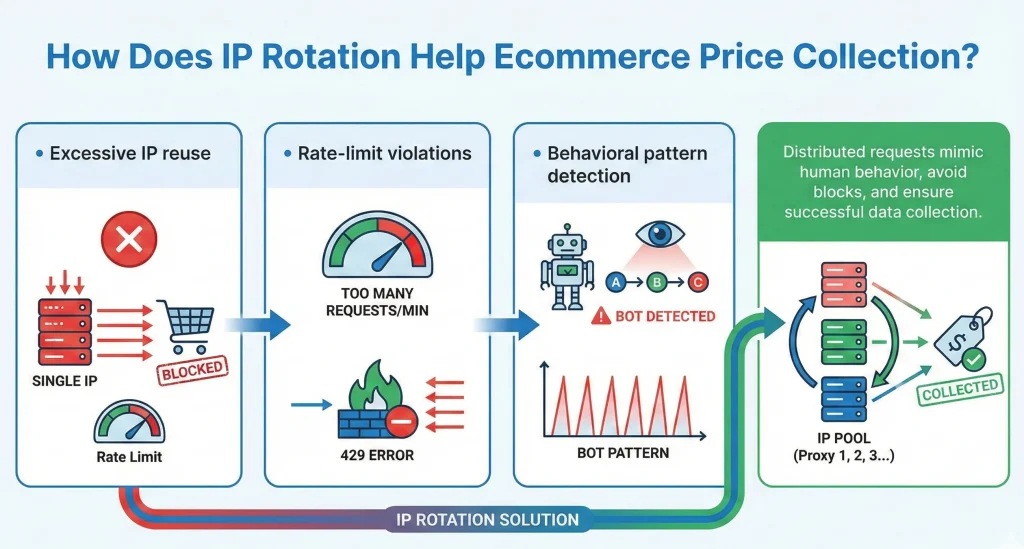
What is IP rotation?
IP rotation distributes scraping traffic across thousands or millions of IP addresses instead of repeatedly using one IP.
This prevents:
- Excessive IP reuse
- Rate-limit violations
- Behavioral pattern detection
Recommended IP Rotation Strategy
| Task | Rotation Method |
| Price comparison scraping | Rotate every request |
| Product detail monitoring | Rotate every 1–5 minutes |
| Logged-in sessions | Sticky residential IP |
| Amazon scraping | Aggressive rotation |
A well-designed e-commerce scraping IP rotation strategy can increase success rates by over 90%.
7 Powerful Ways to Avoid Blocks When Collecting Price Data
1. Use Rotating Residential Proxies
This is non-negotiable.
Residential proxies provide:
- Real ISP reputation
- Massive IP diversity
- Minimal CAPTCHA triggers
They are widely considered the best proxies for e-commerce price scraping.
2. Match IP Location with Website Region
Always align the proxy location with the marketplace region:
- US IP → Amazon.com
- UK IP → Amazon.co.uk
- DE IP → Amazon.de
Geo-mismatch is a major red flag for anti-bot systems.
3. Control Request Frequency
Avoid aggressive crawling.
Recommended limits:
- Category pages: ≤ 1 request per second
- Product pages: ≤ 1 request every 3–5 seconds
Slow and steady always outperforms speed.
4. Maintain Browser Fingerprint Consistency
Ensure consistency across:
- User-Agent
- Headers
- Language
- Timezone
- Screen resolution
Mismatched fingerprints cause instant detection—even with good proxies
5. Use Session Persistence Where Needed
Some e-commerce sites expect short user sessions.
Sticky residential sessions help when:
- Loading multi-step pages
- Accessing JS-rendered prices
- Browsing multiple SKUs
6. Monitor Data Accuracy Continuously
Always validate:
- Currency symbols
- Decimal formats
- Discount labels
- Price consistency across requests
This prevents hidden soft blocks.
7. Avoid Free or Shared Proxy Pools
Free proxies often suffer from:
- Overused IPs
- Previous bans
- Injected scripts
- Fake HTML responses
They almost guarantee inaccurate pricing data.
Why OKKProxy Works for E-commerce Price Monitoring
Based on real operational data, most scraping failures are caused by poor IP quality, not scraping logic.
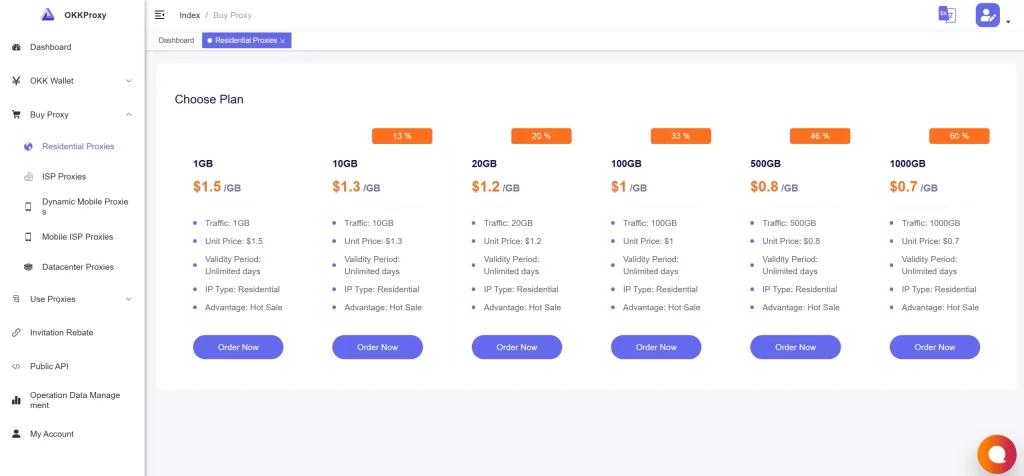
OKKProxy rotating residential proxies offer:
- Millions of real residential IPs
- Continuously refreshed proxy pools
- Flexible IP rotation rules
- Country and city-level targeting
- Sticky and rotating session support
This makes OKKProxy highly effective for large-scale ecommerce price data collection.
Residential proxy pricing: https://okkproxy.com/pricing/residential-proxies
Common E-commerce Price Data Use Cases
- Competitor price tracking
- Dynamic repricing systems
- Regional discount monitoring
- MAP compliance enforcement
- Product intelligence dashboards
Popular search intents include:
- rotating residential proxies for e-commerce scraping
- price monitoring tools
- web scraping without getting blocked
Internal Resources from OKKProxy
For deeper learning, explore these guides:
- Datacenter vs Residential IPs
- Top 10 Rotating Residential Proxies Guide
- What Is a Residential Proxy?
- How to Choose a Proxy for Web Scraping
- How IP Rotation Improves Scraping Success Rate
FAQ: E-commerce Price Data Collection
What proxy works best for e-commerce price scraping?
Rotating residential proxies with large IP pools and flexible session control.
Can I collect e-commerce prices without getting blocked?
Yes—by combining:
- Residential IP rotation
- Low request rates
- Browser fingerprint consistency
- Geo-targeted proxies
Are datacenter proxies still usable?
Only for very small-scale testing. They are unsuitable for long-term price monitoring.
Why do prices differ by location?
E-commerce platforms apply:
- Regional taxes
- Currency conversion
- Market-based pricing
Accurate geo-IP simulation is essential.
Final Thoughts
E-commerce price data collection is no longer about brute-force scraping.
Success today depends on:
- Real residential IP authenticity
- Intelligent proxy rotation
- Human-like traffic behavior
- Continuous accuracy validation
Businesses that rely on outdated scraping methods face:
- Frequent blocks
- Incorrect prices
- Unreliable analytics
With a high-quality residential proxy network and proper rotation strategy, accurate price intelligence becomes scalable, sustainable, and profitable.
When pricing decisions drive revenue, data reliability matters more than speed—and the right proxy infrastructure makes all the difference.
Please watch our video about e-commerce price data collection on YouTube below: