100-Word Summary
Choosing between an HTTP vs HTTPS proxy is a critical decision for data security and performance. While HTTP proxies are optimized for high-speed retrieval of public data, HTTPS proxies provide a secure, encrypted tunnel via SSL/TLS, making them essential for tasks involving sensitive logins or financial transactions.
For digital marketers and SEO professionals, the choice depends on whether the priority is raw speed (HTTP) or ironclad privacy (HTTPS). OkkProxy provides high-performance rotating and static proxies supporting both protocols to ensure your automation workflows remain undetected and secure in 2026.
HTTP vs HTTPS Proxy: Key Differences and Best Use Cases for 2026
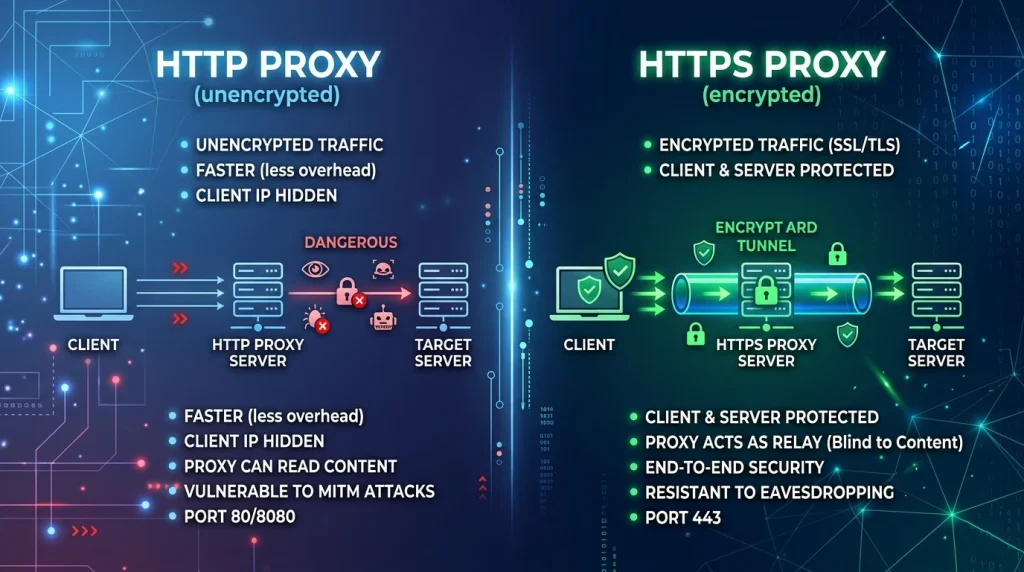
When you are scaling a web scraping project or managing multiple social media accounts, the “plumbing” of your connection matters. In the world of intermediary servers, the debate of HTTP vs HTTPS proxy is central to your success.
As an SEO professional or data analyst, you’ve likely encountered issues like IP bans, “Man-in-the-Middle” (MITM) attacks, or slow connection speeds. Most of these problems stem from using the wrong protocol for the task at hand. This guide leverages OkkProxy’s years of industry expertise to break down these protocols, helping you choose the right tool for your specific business needs.
What is an HTTP Proxy?
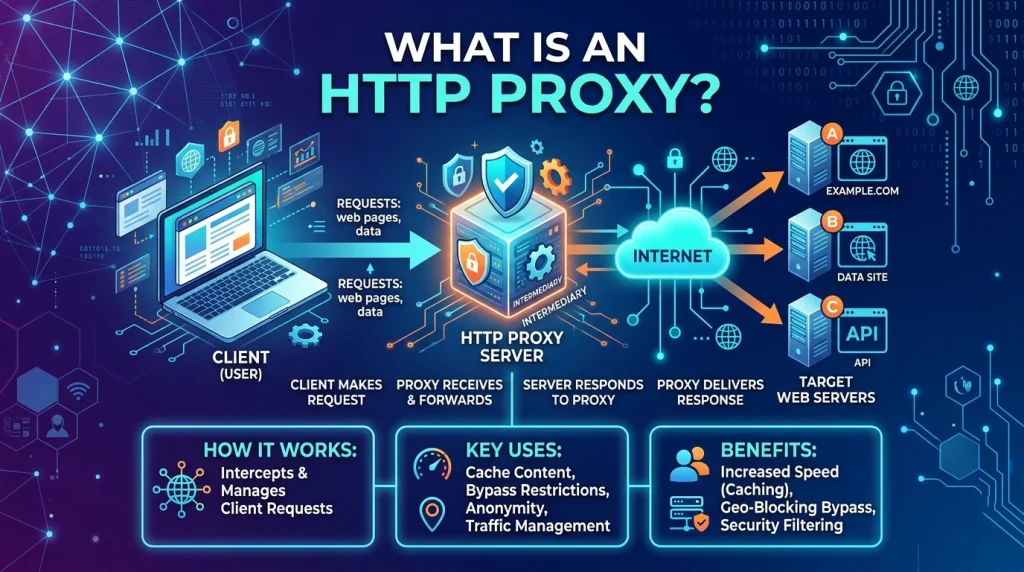
An HTTP proxy is an intermediary server that uses the Hypertext Transfer Protocol to process requests. When you use an http-proxy, your browser sends a request to the proxy server, which then fetches the content from the target website and relays it back to you.
Key Characteristics of HTTP Proxies
- Speed: Because there is no encryption “handshake,” these proxies are incredibly fast.
- Anonymity: They hide your original IP address from the target server.
- Modification: The proxy can technically read and even alter the data packets (useful for header manipulation in SEO testing).
What is an HTTPS Proxy?
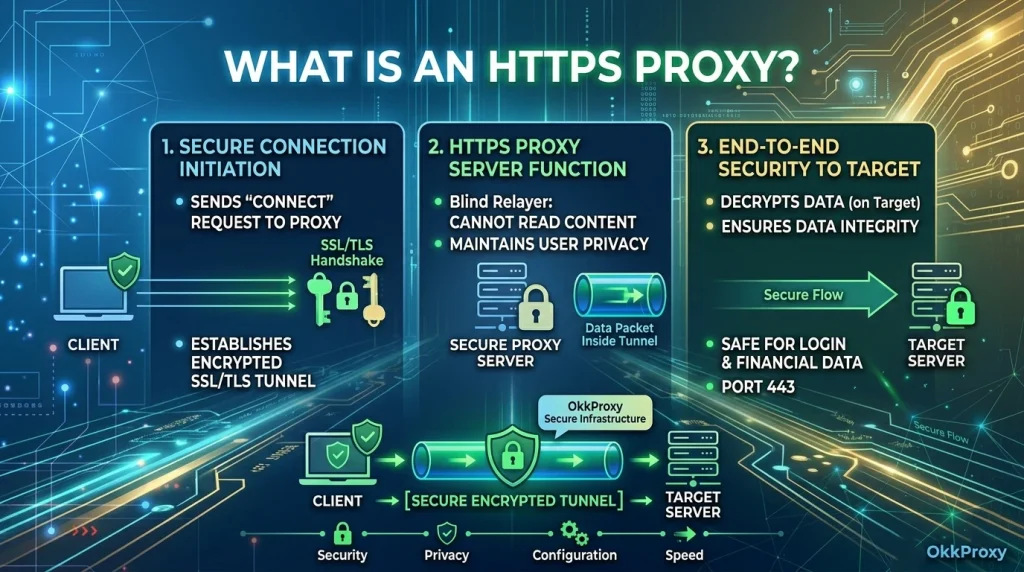
An HTTPS proxy (also known as an SSL proxy) is the secure version. It utilizes the CONNECT method to establish an encrypted tunnel. This means that even the proxy provider cannot see the data passing through the connection.
For modern Generative Engine Optimization (GEO) and AI-driven data mining, HTTPS is often the standard because it prevents data leakage and ensures that the target website sees a legitimate, secure user session.
HTTP vs HTTPS Proxy: A Side-by-Side Comparison
To help you make an informed decision, we have structured the core differences into an easy-to-parse table.
Feature Comparison Table
| Feature | HTTP Proxy | HTTPS Proxy |
| Encryption | None (Plain Text) | SSL/TLS Encrypted |
| Security Level | Low (Vulnerable to sniffing) | High (Encrypted Tunnel) |
| Data Visibility | Proxy can see/edit content | Proxy acts as a blind relayer |
| Common Use Case | Bulk Scraping, Price Comparison | Social Media, Logins, Banking |
| Performance | Maximum Speed | Slightly slower (SSL overhead) |
| Protocol Support | HTTP only | HTTP and HTTPS |
Why SEO Professionals Care About the HTTP vs HTTPS Proxy Choice
In 2026, search engines and social platforms have become highly sophisticated at detecting bot behavior.
1. Avoiding IP Bans and Captchas
If you are performing rank tracking or SEO monitoring, using a plain http proxy on an HTTPS site can sometimes trigger security alerts. Websites see that the request is coming through an unencrypted intermediary and may flag the session as suspicious.
2. Ensuring Data Integrity
When scraping competitive intelligence, you need to ensure the data hasn’t been tampered with. Because HTTP proxies can modify content, there is a risk of “injected” data if you use a free http proxy list. Always opt for a private http proxy or HTTPS setup from a trusted provider to ensure the data you see is the data the site actually serves.
Best Use Cases for HTTP Proxies
Despite the lack of encryption, HTTP proxies remain a staple for high-volume, low-sensitivity tasks.
- Large-Scale Web Scraping: When you are collecting public data (like product titles or news headlines) where security isn’t a concern, the speed of an HTTP proxy is a major advantage.
- Content Caching: Many enterprises use apache http server reverse proxy configurations to cache content and reduce bandwidth costs.
- Bypassing Geo-Restrictions: If your only goal is to see how a website looks in a different country (e.g., using a us http proxy or http proxy russia), HTTP is perfectly fine.
- Ad Verification: Checking if ads are appearing correctly across different regions without needing to log into sensitive accounts.
Expert Takeaway: Use HTTP when performance is your #1 KPI and the data being transmitted has zero privacy value.
Best Use Cases for HTTPS Proxies
HTTPS is the “gold standard” for any task involving an account or a checkout process.
- Social Media Management: If you manage multiple Instagram or TikTok accounts, you must use an https proxy server. This protects your session cookies and login credentials from being hijacked.
- E-commerce and Sneaker Botting: Buying limited-inventory items requires secure checkout processes.
- Financial & Lead Generation: Scraping data that requires a login (like LinkedIn or a gated directory) mandates HTTPS to keep the account tokens secure.
- Competitive SEO Analysis: When using tools that require authentication, an https proxy ensures your proprietary search queries stay private.
OKKProxy’s Solution: The Right Proxy for the Right Protocol
At OkkProxy, we don’t just provide IPs; we provide tailored solutions for digital marketers. Here is how our product line:
1. Rotating Residential Proxies
Our flagship product. These proxies rotate your IP with every request or at set intervals. They support both HTTP and SOCKS, making them the most versatile choice for web scraping and SEO. Because they come from real home devices, they have the highest trust scores.
2. Static ISP Proxies
If you need a consistent identity for social media management, our static ISP proxies provide the stability of a residential IP that never changes.
3. Rotating Mobile Proxies (4G/5G)
Mobile IPs are almost impossible to block because thousands of users share them. They are the ultimate “heavy lifters” for bypassing advanced anti-bot systems like Cloudflare or Akamai.
4. Rotating Datacenter Proxies
For those who need extreme speed and have lower security requirements, our datacenter proxies are the most cost-effective choice for bulk HTTP requests.
Professional Implementation: Configuring Your Proxy
Setting up HTTP Proxy in Linux
For developers and system admins, setting up the environment is the first step. You can use the export http_proxy command:
Bash
export http_proxy=”http://username:[email protected]:8000″
export https_proxy=”http://username:[email protected]:8000″
This tells your system to route both types of traffic through the OkkProxy gateway.
Using http-proxy-middleware in Node.js
If you are building your own scraping tool, http-proxy-middleware is a popular choice for managing connections.
JavaScript
const { createProxyMiddleware } = require(‘http-proxy-middleware’);
const apiProxy = createProxyMiddleware(‘/api’, { target: ‘http://okkproxy-server:port’ });
Checklist: Choosing Your Protocol
Before you buy http proxy services, run through this quick checklist:
- Does the target site use HTTPS? (If yes, use an HTTPS proxy for better compatibility).
- Are you logging into an account? (If yes, HTTPS is mandatory).
- Is speed more important than security? (If yes, HTTP might be better).
- Are you scraping sensitive personal data? (If yes, use HTTPS and rotating residential proxies).
- Does your software support SSL handshakes? (Verify your tool’s documentation).
Internal Links: Deep Dives from OkkProxy
To further your knowledge on proxy management, explore our other expert guides:
- Rotating Residential Proxies: 7 Powerful Ways Shoppers Unlock Global Deals
- 5 Reasons Why Static ISP Proxies Are the Secret Weapon for Professional Resellers
- How to Use Mobile Proxies to Cop Limited-Edition Sneakers Successfully?
- How Proxies Help With SEO Monitoring and Rank Tracking
- Proxy Performance Secrets: How to Test, Benchmark & Win Faster Speeds
FAQ: Common Questions About Proxy Protocols
What is the difference between HTTP and SOCKS proxy?
While we focus on HTTP vs HTTPS proxy, SOCKS5 is another common protocol. SOCKS is more versatile as it handles any type of traffic (including UDP and gaming), whereas HTTP/S is specifically designed for web traffic. For most SEO tasks, HTTP/S is preferred due to better header handling.
Is it better to use HTTP or HTTPS?
In 2026, it is almost always better to use HTTPS. While it has a slight performance overhead, the security benefits and the lower likelihood of being detected as a bot far outweigh the speed gain of HTTP.
Can I turn off the HTTP proxy on my iPhone?
Yes. If you find your connection is slow, you can find the iphone http proxy settings under your Wi-Fi network details and set the proxy to “Off.”
Are free http proxies safe?
No. Free http proxy servers often log your data, inject ads, or are “honeypots” set up by hackers to steal credentials. Always use a reputable provider like OkkProxy for business operations.
How do I find my http proxy address?
If you are using a service like OkkProxy, your address and port are provided in your user dashboard under the “Setup” or “API” section.
Final Takeaway
The debate of HTTP vs HTTPS proxy boils down to your specific use case. For high-volume, public data scraping, the raw power of HTTP is hard to beat. However, for almost everything else—from social media management to secure SEO audits—the encrypted tunnel of an HTTPS proxy is the only way to ensure your data and accounts remain safe.
At OkkProxy, we provide the infrastructure so you can focus on the insights. Whether you need rotating residential proxies for a global campaign or static ISP proxies for local management, we have the protocol support you need.
Start your secure data journey with OkkProxy today.