Executive Summary
In modern networking, the debate of Reverse Proxy vs Forward Proxy defines how we secure and scale the internet. A forward proxy acts on behalf of clients (users) to mask identities and bypass geo-blocks, while a reverse proxy acts on behalf of servers to balance traffic and provide a security shield.
For businesses, choosing the right configuration—paired with premium rotating residential proxies—is the secret to uninterrupted web scraping and data accuracy.
What is Proxy and Reverse Proxy? The Foundation of Modern Web Traffic
To navigate the digital landscape effectively, digital marketers and data analysts must understand the gatekeepers of web traffic. At its core, a proxy is an intermediary server. However, its position in the network flow determines whether it is a “Forward” or “Reverse” tool.
A Simple Analogy to Understand Proxy vs Reverse Proxy Server
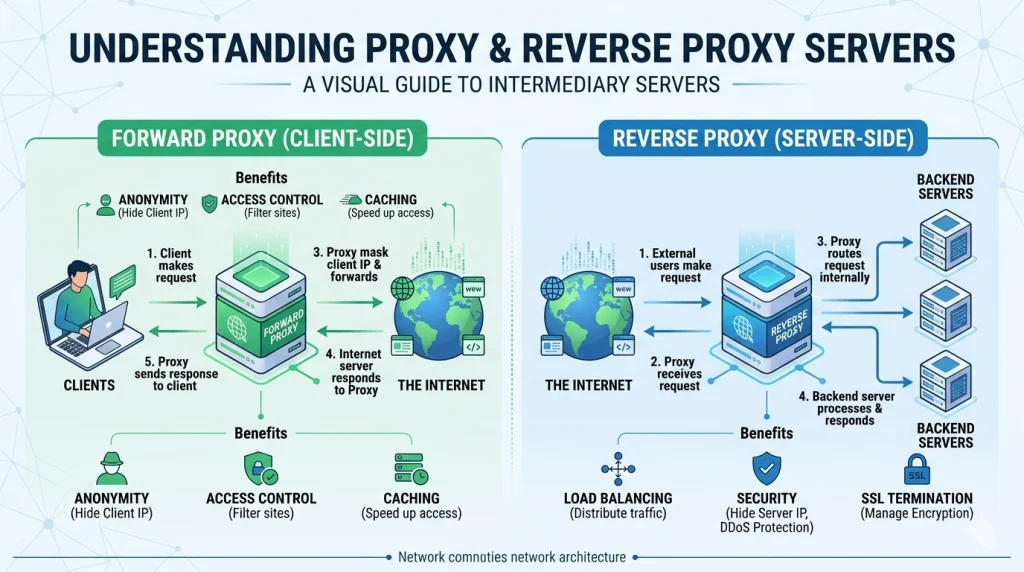
- Forward Proxy (The Protective Shield for Users): Imagine a private investigator who makes phone calls for a client. The person on the other end knows the investigator is calling, but they never know who the actual client is. This is how a forward proxy protects user privacy.
- Reverse Proxy (The Elite Concierge for Servers): Imagine a luxury hotel where guests talk to a concierge. The guest doesn’t know which specific housekeeper or chef is handling their request; they only see the concierge. This is how a reverse proxy manages incoming requests for a backend server cluster.
What is Forward Proxy? (The Client-Side Solution)
A forward proxy server sits in front of a group of client machines. When those clients send requests to resources on the internet, the forward proxy intercepts them.
How Does a Forward Proxy Work?
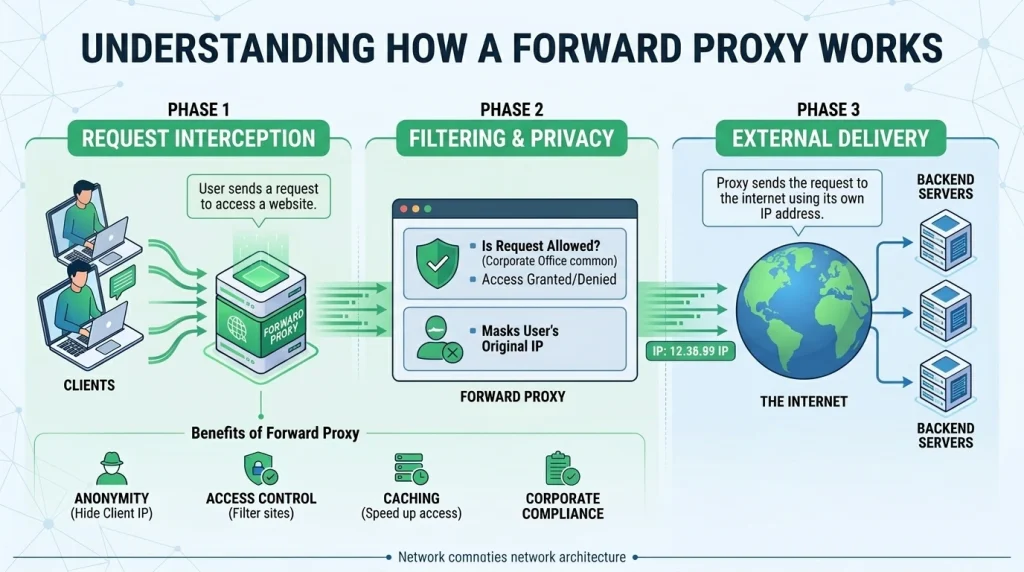
- Request Interception: The user sends a request to access a website.
- Filtering & Privacy: The proxy checks if the request is allowed (common in corporate offices) and masks the user’s original IP.
- External Delivery: The proxy sends the request to the internet using its own IP address.
For SEO professionals, using a forward proxy is essential for rank tracking and ad verification. By using OKKProxy’s rotating residential proxies, your requests appear as though they are coming from real home-based users, effectively eliminating the risk of IP bans.
What is a Reverse Proxy? (The Server-Side Powerhouse)
Unlike its counterpart, a reverse proxy sits in front of web servers. When a user from the internet makes a request, it hits the reverse proxy before ever reaching the backend database or application server.
What is a Reverse Proxy Used For?
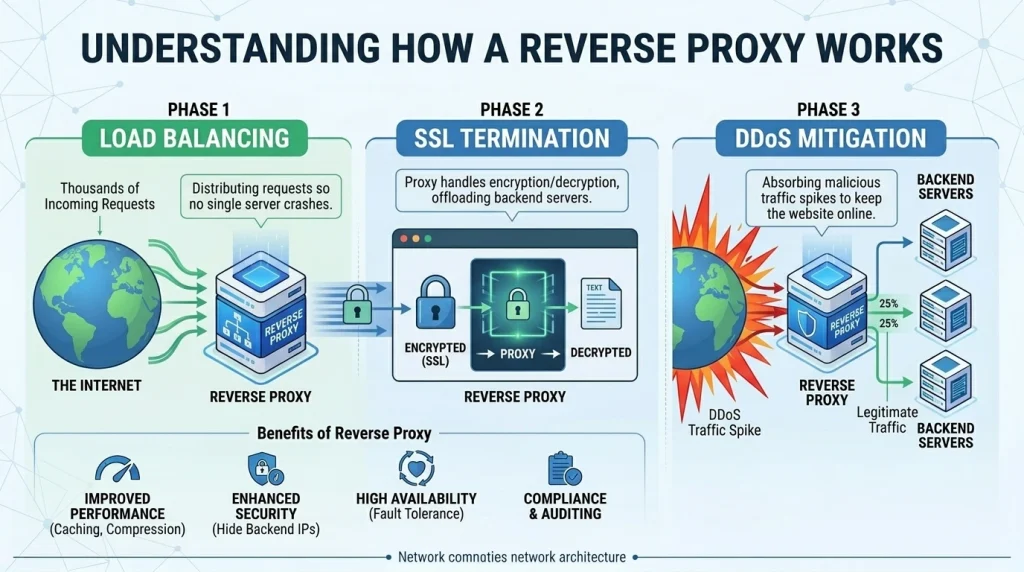
- Load Balancing: Distributing thousands of incoming requests across multiple servers so no single server crashes.
- SSL Termination: Handling the encryption/decryption of data to take the load off the backend servers.
- DDoS Mitigation: Absorbing malicious traffic spikes to keep the website online.
Does a Reverse Proxy Increase Security?
Absolutely. One of the biggest advantages of what reverse proxy does is hiding the identity and internal structure of your backend servers. If a hacker tries to attack the site, they only see the proxy’s IP, not the vulnerable server where the data actually lives.
Reverse Proxy vs Forward Proxy: 5 Key Differences You Need to Know
To help you decide which setup fits your business needs, we’ve broken down the technicalities into this comparison table:
| Feature | Forward Proxy | Reverse Proxy |
| Primary Beneficiary | The Client (User) | The Server (Website Owner) |
| Traffic Direction | Outbound (Internal to Web) | Inbound (Web to Internal) |
| Anonymity Goal | Hides the User’s IP | Hides the Server’s IP |
| Common Use Case | Bypassing blocks, web scraping | Load balancing, DDoS protection |
| Recommended OKKProxy Product | Rotating Mobile Proxies | Infrastructure-based Nginx/HAProxy |
Why SEO and Data Professionals Care About Proxies
If you are a digital marketer, you are likely dealing with Reverse Proxy vs Forward Proxy logic every day without realizing it.
1. Overcoming IP Blocking and Captchas
Platforms like Google and Amazon use sophisticated reverse proxies to identify and block bot-like behavior. To scrape this data successfully, you need a high-quality forward proxy. OKKProxy’s rotating residential proxies provide millions of real household IPs, allowing you to mimic human behavior and avoid the “Access Denied” screen.
2. Ensuring Data Accuracy with Static ISP Proxies
For account management (like managing multiple social media profiles), consistency is key. A static ISP proxy combines the speed of a datacenter proxy with the high reputation of a residential IP. This ensures that the reverse proxies of platforms like Facebook or LinkedIn recognize you as a trusted, consistent user.
Use Cases for Reverse Proxies vs Forward Proxies
What are some use cases for reverse proxies?
- E-commerce Sites: Using a reverse proxy as a load balancer to handle Black Friday traffic.
- Global Content Delivery: Caching static content (images/videos) closer to the user to reduce latency.
- API Gateways: Managing how different mobile apps communicate with a single database.
What are some use cases for forward proxies?
- Web Scraping: Using rotating datacenter proxies for high-speed data extraction.
- Geo-Targeting Tests: Checking how a website looks to users in Tokyo vs. New York using rotating mobile proxies.
- Corporate Security: Preventing employees from accessing malicious websites.
OKKProxy’s Expert Insight: The Hybrid Approach
In our experience at OKKProxy, the most successful enterprises don’t just choose one. They use a Forward Proxy (like our rotating residential proxies) to gather intelligence and a Reverse Proxy (like Nginx) to protect their own internal assets.
The Takeaway:
- Use a Forward Proxy to go out and get data.
- Use a Reverse Proxy to let users in safely.
FAQ: Clearing the Technical Jargon
What is reverse proxy vs load balancer?
A load balancer is a specific type of reverse proxy. While all load balancers are reverse proxies, not all reverse proxies are used for load balancing (some are just for security or caching).
Is VPN a reverse proxy?
No. A VPN is a type of encrypted tunnel that acts more like a forward proxy. It protects the client, not the server.
How to check if reverse proxy is working?
You can use tools like cURL or browser developer tools to check the “Server” header in the HTTP response. If it shows “Nginx” or “Cloudflare” instead of your specific app server, the reverse proxy is active.
How to setup reverse proxy?
The most common way is to configure a reverse proxy using Nginx. You define an “upstream” block with your server IPs and use the proxy_pass directive to route traffic.
Internal Links to Boost Your Knowledge:
- Proxy Rotation: How It Secures Better Deals Online
- How IP Rotation Improves Success Rates in Mobile Automation Tasks?
- Top 10 Rotating Residential Proxies Tips: Ultimate 2026 Guide
- OkkProxy Ultimate Guide to Static ISP Proxies: Everything You Need to Know
- How To Access Geo-Restricted Mobile Streaming Content While Traveling
Conclusion
Understanding the architecture of Reverse Proxy vs Forward Proxy is the first step toward building a resilient data strategy. Whether you are trying to bypass a competitor’s reverse proxy or secure your own infrastructure, the quality of your IP addresses is the deciding factor.
OKKProxy Offers:
- Rotating Residential Proxies: Best for scraping and avoiding bans.
- Static ISP Proxies: Ideal for stable account management.
- Rotating Mobile Proxies: Ultimate trust scores for social media.
- Rotating Datacenter Proxies: Cost-effective, high-speed solutions.
Don’t let IP blocks stop your growth. Check out OKKProxy’s pricing and start your trial today!