
Summary: The Mobile IP Paradox
Mobile proxies offer unmatched security and trust because they use real cellular IP addresses that websites rarely block. However, they can feel unstable due to aggressive network-driven IP rotation, signal fluctuations, and shared IP environments through Carrier-Grade NAT (CGNAT).
This comprehensive guide explains why this paradox exists, breaks down how mobile IPs work, and provides a clear methodology to help you balance stability and anonymity using okkproxy’s advanced proxy infrastructure.
5 Reasons Why Mobile Proxies Feel Safer but 100% Way More Chaotic
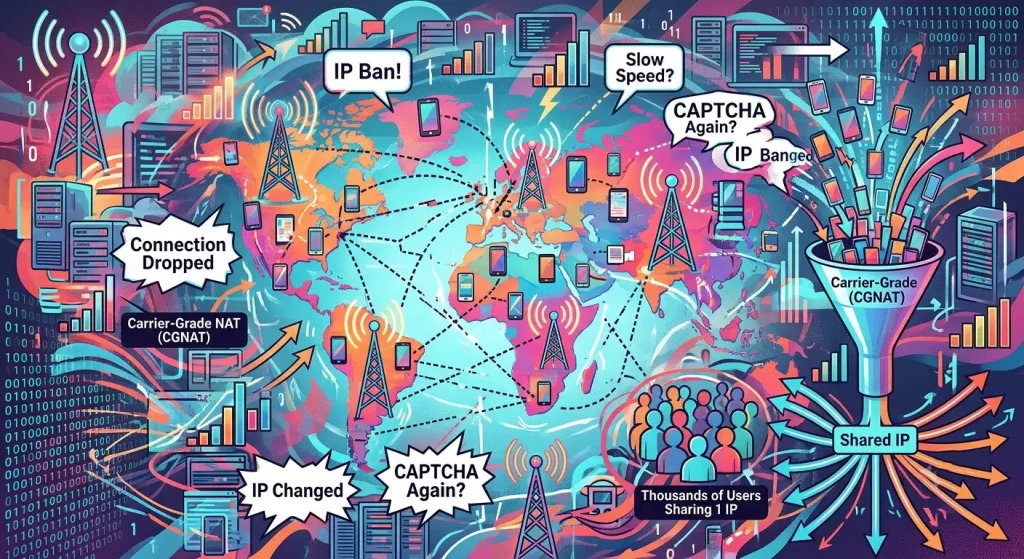
If you manage automation scripts, scrape complex data structures, or maintain multiple social media profiles, you have likely asked yourself: Why do some mobile proxies feel safer but way more chaotic? When you connect through a mobile proxy, websites treat you like royalty. You rarely get blocked, your scripts slip past advanced anti-bot walls effortlessly, and your accounts feel bulletproof. Yet, at the exact same time, your connections might drop, your downloads might stall midway, and your dashboard latency can fluctuate wildly.
This is the central paradox of the mobile proxy server. To understand why a mobile proxy feels incredibly secure yet fundamentally erratic, we have to look beneath the surface at how telecommunications networks operate.
At okkproxy, we manage an enterprise network that routes millions of requests daily across rotating residential proxies, static ISP proxies, and rotating mobile proxies. Time and again, our clients experience this exact love-hate relationship before optimizing their configurations.
Let’s break down the technical realities of how mobile proxies work, why they provide unparalleled anonymity, and how you can tame their inherent turbulence.
What Are Mobile Proxies and How Do They Work?
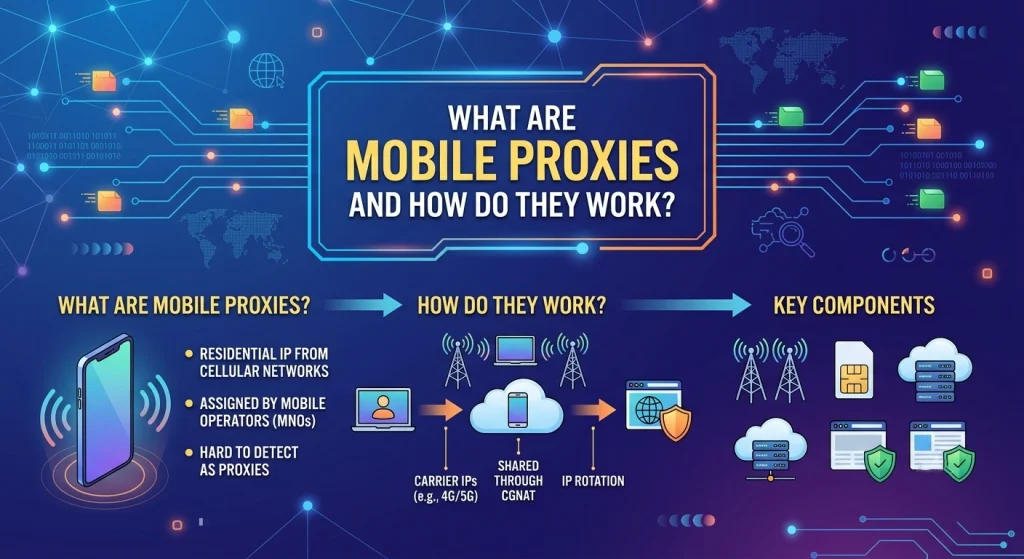
Before diving into the core mechanics, let’s establish a clear definition to satisfy your search intent.
What is a mobile proxy?
A mobile proxy is a gateway server that routes your internet traffic through an internet-connected mobile device—such as a smartphone or a cellular dongle—using a data plan from a mobile network operator (MNO) like AT&T, T-Mobile, or Vodafone.
When you use an online mobile proxy, the destination website does not see your home or server IP address. Instead, it sees a legitimate mobile IP assigned by a real telecom carrier.
The Underlying Technology: Carrier-Grade NAT (CGNAT)
The secret to both the safety and the chaos of mobile proxies lies in a networking technology called Carrier-Grade NAT (CGNAT).
Because the world ran out of IPv4 addresses years ago, mobile network operators cannot assign a unique public IP address to every single smartphone on their network. Instead, carriers use CGNAT to assign a single public mobile network proxy IP address to thousands of distinct mobile devices simultaneously.
As noted in the foundational academic documentation regarding internet protocols, this shared infrastructure fundamentally alters how websites evaluate web traffic. According to industry-leading tracking indices like the IETF Internet Standards Archive, CGNAT hides individual device identities behind massive, highly trusted carrier nodes.
Why Mobile Proxies Feel Safer (The Protection)
When executing sensitive tasks like market research or social media automation, choosing a mobile proxy website or a dedicated mobile proxy service feels like wearing an invisibility cloak. Here is the technical breakdown of why these proxies are so incredibly safe.
1. Total Immunity from Broad IP Bans
Because thousands of regular citizens share the exact same public IP via CGNAT, major platforms like Google, Instagram, and Amazon cannot simply block a mobile IP proxy when they detect suspicious behavior.
Real-World Impact: If Instagram blocks a single 4g mobile proxy IP because an automated script made too many requests, it might accidentally block thousands of legitimate, paying cell phone users who are connected to the exact same cell tower. To avoid this massive collateral damage, websites almost never issue hard IP bans on mobile carriers.
2. Natural Behavioral Signatures
Anti-bot systems monitor structural browser fingerprints and network signatures. Traffic coming from 4g lte mobile proxies or 5g mobile proxies fits perfectly into the noise of organic daily internet behavior. The traffic naturally exhibits mobile-specific properties, making it highly effective at bypassing strict bot-detection algorithms.
3. High IP Trust Scores
IP reputation tracking systems (such as MaxMind or IPInfo) label these addresses as “Cellular.” These IPs have the highest possible trust metrics because they are issued by real telecom companies. Whether you buy a private mobile proxy, a cheap mobile proxy, or utilize a premium usa mobile proxy, you are inheriting the pristine reputation of a household telecom brand.
Why Mobile Proxies Feel Chaotic (The Turbulence)
While the safety metrics of a mobile web proxy are unmatched, the infrastructure introduces distinct operational hurdles. If you are experiencing connection drops, here is exactly why it happens.
1. The IP Crossfire Effect
Because you are sharing a public IP with hundreds of others through CGNAT, you are vulnerable to the actions of neighbors on that same IP. If someone else is aggressively scraping a platform on your assigned carrier IP, you might suddenly face a wall of CAPTCHAs. Your traffic is caught in an “IP crossfire,” causing unexpected friction.
2. Aggressive Network-Driven IP Rotation
Unlike a static ISP proxy or a static mobile proxy that maintains a constant address, cellular networks are built for mobility. As devices move between cell towers, or as cell towers experience bandwidth congestion, the MNO forces an IP change.
If your proxy architecture isn’t configured for a specific “sticky session” length, your connection will abruptly refresh. This causes active web scraping sessions to fail or browser logins to crash mid-way.
3. Inherent Signal and Speed Fluctuations
A wired connection in a data center is predictable. A cellular connection is not. Your 4g mobile proxy speeds depend heavily on local cellular network coverage, signal strength, hardware overheating, and peak-hour network throttling. This makes the performance of an anonymous proxy mobile inherently more erratic than fixed-line alternatives.
Comparing Proxy Architectures: Which Type of Proxy is the Best?
To choose the right tool for your specific project, it helps to look at how a mobile residential proxy stacks up against alternative options in the okkproxy ecosystem.
| Proxy Type | IP Source | Trust Level | Stability | Best Use Case |
| Rotating Datacenter Proxies | Cloud Hosting Providers | Low | Very High | High-speed, mass data scraping on low-security sites |
| Static ISP Proxies | Consumer ISPs (Wired) | High | Excellent | E-commerce management, managing core business accounts |
| Rotating Residential Proxies | Home Wi-Fi Networks | High | Moderate | Ad verification, localized market research, scaling operations |
| Rotating Mobile Proxies | Mobile MNOs (4G/5G) | Highest | Variable | Bypassing advanced anti-bot systems, social media multi-accounting |
| Static Mobile Proxies | Fixed Cellular Lines | Highest | High | Creating accounts, specialized mobile application testing |
Practical Guide: How to Connect and Configure a Mobile Proxy
Setting up your proxy correctly is essential for maintaining stability. Below are practical blueprints covering how to use and manage mobile proxies across multiple devices and environments.
How to set proxy in mobile wifi connection (Android & iOS)
For Android Devices:
- Open Settings and tap on Network & Internet > Internet (or Wi-Fi).
- Tap the Gear Icon next to your connected Wi-Fi network.
- Tap the Modify/Edit (Pencil) Icon at the top right.
- Expand Advanced Options, tap Proxy, and switch it from None to Manual.
- Enter your okkproxy details: Proxy Hostname (e.g., pr.okkproxy.com) and Proxy Port.
- Tap Save. Open your browser; a prompt will appear asking for your proxy username and password.
For iOS (iPhone):
- Open Settings and go to Wi-Fi.
- Tap the “i” icon next to your active network connection.
- Scroll down to the bottom and select Configure Proxy.
- Change the setting to Manual.
- Enter your Server, Port, and toggle Authentication to ON to fill in your Username and Password.
How to change proxy settings in chrome mobile and Firefox Mobile
Many users wonder how to change proxy settings in chrome mobile or how to use proxy on mobile data without changing system-wide configurations. While mobile Chrome relies heavily on your device’s global network configuration, Firefox mobile users can follow this manual walkthrough to configure an isolated setup:
- Step 1: Open Firefox on your mobile device.
- Step 2: Type about:config into the address bar.
- Step 3: Search for the preference name network.proxy.type and change its integer value to 1 (which forces manual proxy configuration).
- Step 4: Search for network.proxy.http and input your okkproxy server address.
- Step 5: Search for network.proxy.http_port and input your assigned port number.
How to set proxy on mobile data (Cellular Connections)
Configuring a proxy to run directly over an active cellular data connection requires altering your Access Point Name (APN) settings.
- Navigate to Settings > Network & Internet > Mobile Network.
- Select Access Point Names (APNs).
- Tap your current active carrier APN profile to edit it.
- Locate the Proxy and Port fields.
- Enter your okkproxy gateway credentials directly into these slots.
- Save the settings and toggle your mobile data off and on to initialize the secure tunnel.
Case Study: Resolving the Chaotic Connection in Enterprise E-Commerce
The Problem
An automated inventory synchronization team reached out to the okkproxy support team. They were utilizing a standard 4g lte mobile proxy setup to manage 50 high-ticket seller accounts across e-commerce platforms. The security was excellent—they faced zero account bans. However, they were plagued by “chaotic turbulence.” Their network sessions kept dropping mid-transaction because their previous provider forced random IP rotations every 90 seconds, causing shopping carts to reset and data streams to break.
The okkproxy Methodology & Solution
We migrated their operations to our dedicated rotating mobile proxies ecosystem and applied a three-step optimization strategy:
- Enforced Sticky Sessions: We updated their mobile proxy dashboard for managing carrier ips to hold a 20-minute sticky session window. This stabilized their checkout processes.
- Smart Failover Logic: We configured an automated failover script. If a specific cellular tower faced congestion, their system smoothly transitioned to an alternative proxy port without dropping the active session.
- Hybrid Architecture: We transitioned their static accounts to our static ISP proxies for consistent daily account logins, while keeping the 5g mobile proxies specifically for high-intensity data scraping tasks.
The Result
The team achieved a 99.4% session completion rate, eliminated automated cart drops, and maintained a zero-ban record across all 50 seller profiles.
Frequently Asked Questions (FAQ)
Is proxy legal or illegal?
Using a proxy is completely legal in the vast majority of countries worldwide. Proxies are legitimate tools used by businesses for data privacy, market research, brand protection, and content localization. However, using a proxy to engage in illicit activities, copyright infringement, or unauthorized cyber access remains illegal. Always ensure your use cases comply with your local laws and the target platform’s service terms.
Which type of proxy is the best?
There is no single “best” proxy type; it depends entirely on your project’s requirements.
- If you need high speed and budget efficiency for basic scraping, rotating datacenter proxies work well.
- If you require consistent, long-term stability for corporate account management, static ISP proxies are optimal.
- If you are targeting highly secure platforms with strict anti-bot measures, rotating mobile proxies are the most reliable option.
How do mobile proxies differ from residential proxies?
The primary difference lies in the network connection type. A mobile residential proxy routes traffic through a mobile device using a cellular data network (4G/5G) via CGNAT, meaning the IP is shared among thousands of users. A standard residential proxy routes traffic through a physical household internet connection (like cable or DSL Wi-Fi), which is tied to a fixed physical location.
Are mobile proxies better or worse than residential proxies?
They are better for passing strict, automated anti-bot tests because mobile carrier IPs carry the highest overall trust profiles and are rarely banned. However, they can be more unpredictable regarding connection stability and speed than high-quality residential proxies due to cellular network fluctuations.
What are bad proxies?
Bad proxies are typically free, public proxies or low-quality datacenter blocks that have been blacklisted by major websites. These proxies often leak your true IP address, log your private data, suffer from slow speeds, and cause immediate account bans or endless CAPTCHA challenges.
Can mobile proxies help me access geo-restricted content safely?
Yes. By routing your connection through a high-quality usa mobile proxy or specific regional gateways like spanish mobile proxies, you can view content exactly as a local mobile user would, keeping your real identity fully protected.
Final Checklist: Taming Your Mobile Proxies for Optimal Results
To maximize performance while using mobile proxies, use this operational checklist before launching your next campaign:
- Configure Sticky Sessions: Ensure your dashboard is set to hold an IP for 10 to 30 minutes to avoid unexpected session drops during critical actions.
- Implement HTTP/SOCKS5 Authentication: Protect your connections by enabling SOCKS5 protocols for faster data processing and secure handshakes.
- Verify IP Geolocation: Ensure your proxy’s target location aligns with the timezone and regional configurations of your browser profile.
- Use a Reliable Provider: Avoid free mobile proxy servers that can leak personal data or carry high failure rates. Instead, choose reliable options like okkproxy’s vetted infrastructure.
- Set Up Connection Timeout Rules: Program your automation software to wait at least 15–30 seconds before retrying a connection, allowing the carrier network time to resolve natural tower handovers.
Technical Insights and Deep-Dive Resources
For further reading on proxy optimization, architecture strategies, and managing digital footprints safely, explore our technical deep dives on the okkproxy blog:
- Static IP Selection for Cross-Border E-Commerce: Datacenter IP vs Residential IP
- Mobile vs Residential Proxies Explained: Trust Factors, Differences, and Use Scenarios
- How to Configure a Proxy Browser Extension Like SwitchyOmega?
- How IP Pool Size Affects Proxy Performance
- OkkProxy Guide: What’s the First Thing You Notice When a Proxy Starts Failing?